Aspirant
The Legend of William OhAn Aspirant is a person preparing to earn a Class and become a Climber. The status is defined by incompletion: Aspirants have not yet crossed the Trial’s threshold, but they must already make informed decisions about weapons, Sacrifices, archetypes, and survival. Their transition is neither automatic nor equally accessible. Some people spend days or weeks traveling from civilization’s outskirts to reach the place where Classes can be earned, while those living in the frigid wastes may spend months making the journey. Against that scale, Will’s one-hour walk is unusually easy, though even he must first secure basic supplies.
Status and Preparation
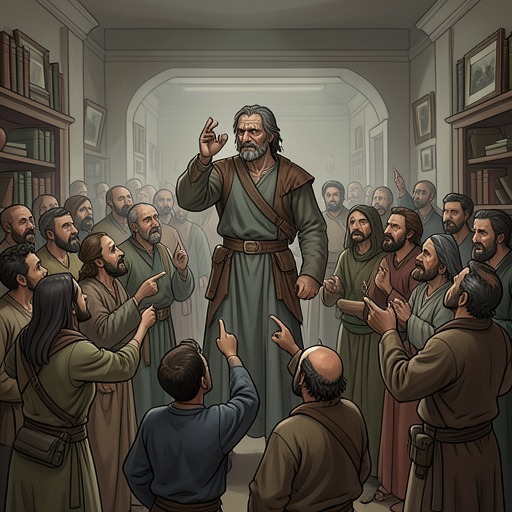
An Aspirant’s immediate obligations are practical as well as symbolic. Before setting out, Will enters Leon’s General Store seeking one sling, two dozen bullets, two pounds of pemmican, and a waterskin. He has saved copper coins for the purchase, yet the shop is crowded with other Aspirants his age buying hunting weapons alongside established Climbers collecting food and toiletries. The scene places Aspirants within a larger climbing economy: they are beginners preparing for a dangerous profession, surrounded by people who have already acquired the equipment, Relics, and experience associated with life as a Climber.
The store also reveals that preparation is shaped by limited resources. Will intends to pay with his saved coins, but the crowd blocks his route to the counter, delaying the small ceremony of proving that he can finance his own departure. His shopping list is modest and survival-oriented rather than luxurious. For an Aspirant, advancement begins not with glory but with ammunition, preserved food, and water.
Sacrifice and Class Choice
A central part of being an Aspirant is selecting a monster Sacrifice whose properties will influence the Classes available during the Trial. While hunting with Ben, Will recognizes a Jumper and recalls the researched terms of its use: the Sacrifice adds leg-based Abilities, mainly kicks and jumps, to an Aspirant’s Class choices; it provides 2 Strength and 1 Kinesthetics per level; it suits unarmed fighters and Scouts; and its parts are valued at 12 copper per leg. The encounter therefore turns an apparently unaware creature into a possible foundation for Will’s future Build.
Not every Sacrifice is equally practical. Will-o’-wisps can be excellent for an Aspirant intending to pursue a Mage archetype because they provide 2 Focus per level and add Illusion and Meta Abilities. Yet they are rarely considered by Aspirants because preserving one is extraordinarily difficult: after the creature is defeated, a magician with the correct Build must immediately capture its essence in a bottle, or it evaporates. The Aspirant’s choice is thus governed by a tension between theoretical power and logistical feasibility. A desirable Sacrifice may be useless if the party cannot preserve it.
The merchant who examines Will’s intended direction identifies him as someone interested in becoming a Climber and focusing on Charge, describing that as a difficult path while recognizing his ambition. The exchange demonstrates that Aspirants are not merely collecting corpses for materials; they are being assessed according to the kind of future Class they hope to create. Their purchases and hunting decisions become early declarations of identity.
The Trial and the Threshold of Climbing
The Aspirant status ends only through a hazardous Trial. In the canyon where Will receives the Trial’s instructions, sheer cliffs imprison him among jagged crags, narrow footholds, and vegetation-covered patches of ground. The objective is to find the portal leading back to the Hunting Grounds. The portal is guarded by a vicious Maksu tribe led by Sezz’kenal, a caravan raider who has developed a taste for human flesh. Returning to the Hunting Grounds qualifies the Aspirant to join The Climb.
This structure makes qualification a physical ordeal rather than a bureaucratic promotion. The Aspirant must navigate an enclosed landscape, locate an exit, and pass a hostile guardian population before receiving access to the wider progression system. The Trial therefore tests both movement and judgment: an Aspirant’s desired Class matters, but so does the ability to survive the environment in which that Class is earned.
The threshold is also carefully marked by system language. The Trial addresses Will as a Climber before confirming that he is qualified to join The Climb, suggesting that the title can be anticipated before it is secured. The Aspirant occupies the unstable interval between recognition and achievement: already addressed according to the role he seeks, yet still required to prove that he deserves it.
Limits, Rules, and Advancement
Even after becoming a Climber, the habits and constraints formed during Aspirant preparation continue to govern advancement. Will and Loth consider following a bus to a higher Floor by helping clear a Key Site, because the rules allow anyone present who does not actively sabotage the other Climbers to receive credit. This is described as the fastest route upward, but the pair are still undergoing Miasma Acclimation and therefore cannot immediately exploit it. Loth also warns that reaching a higher Floor below the current Floor’s maximum permitted level would be foolish.
The episode clarifies what the Aspirant status prepares a person to understand: progression is not simply a race toward elevation. The system rewards participation, but environmental adaptation and level limits impose their own timetable. A newcomer may be technically eligible to benefit from another Party’s momentum while remaining practically unready to do so.
Narrative Significance
The Aspirant concept organizes the book’s recurring contrast between aspiration and exposure. It promises access to Classes, Abilities, and The Climb, but it places that promise behind costly choices and immediate bodily danger. The status turns ambition into a material process: buying pemmican and water, researching the value of a Jumper, judging whether a Will-o’-wisp can be preserved, surviving a canyon, and resisting the temptation to advance before acclimation is complete.
Because Aspirants stand at the boundary between ordinary people and professional Climbers, they also provide the clearest view of the world’s hierarchy. The crowded store contains beginners and veterans in the same space, but their different equipment and confidence reveal how far apart those stages are. The Aspirant is therefore not simply a beginner label. It is a narrative position defined by preparation under pressure, where every provisional choice helps determine whether the character will ever reach the Class and status being pursued.